Skip to content

FD503 material applications

BESS battery management

Battery-monitoring systems can use FD503 in their separate board compartment.
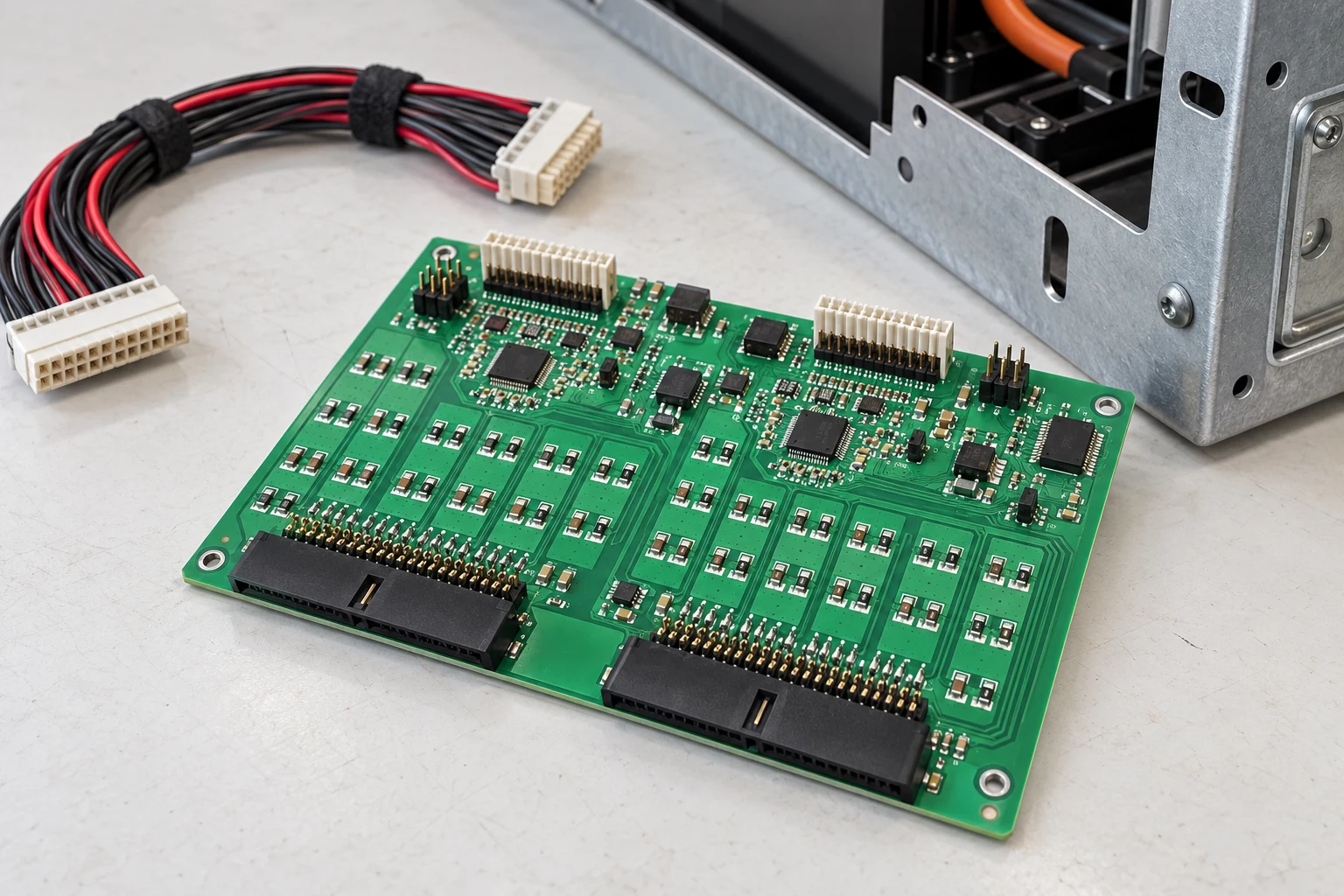
Battery monitoring circuit board with repeated cell channels and sense connectors beside a battery drawer
Illustrative image: potential FD503 application.

Material supply

FD503 grades

Full grade comparison

FD503-TG60S

TG60S is a low-viscosity option for a separate battery-monitoring board compartment.

Flame-retardant rating
V-0 (UL 94), as listed in the TDS
Mixed viscosity
600-1,200 cps
Working time
30-60 min

FD503-TG101

TG101 is an option around balancing electronics when heat can reach the housing and coverage stays consistent across channels.

Thermal conductivity
≥0.9 W/m·K
Mixed viscosity
2,500 ± 1,000 cps
Working time
At least 30 min

FD503-TG60E

TG60E’s low-viscosity mix helps fill narrow gaps around the rack-control supply’s isolation transformer.

Thermal conductivity
≥0.6 W/m·K
Mixed viscosity
1,500-2,500 cps
Working time
30-50 min

TG60S lists V-0 (UL 94) in its TDS. Thermal conductivity, specimen thickness and a test report are not provided. A material rating does not establish the finished assembly’s rating.

Potential potting locations

Cell-monitor board
The board reads voltage and temperature through a multichannel harness. Sensitive input circuits need leakage and accuracy checks after filling.
Balancing circuit
Resistors and switches release heat while balancing cells. Their heat path should leave removable sense connectors accessible.
Rack control supply
An isolated converter powers the rack controller and communication circuits, in a separate space from the main battery conductors.

Application testing

Compatibility, cure and assembly performance need testing with the production materials and process.

Readings and communication
Tests should compare cell-voltage error, temperature readings and communication between boards before and after filling across the specified rack temperature range.
Balancing temperatures
The longest planned balancing cycle should include realistic channel combinations, with temperatures recorded at resistors, monitor ICs and nearby connectors.
Condition after cycling
Temperature cycling needs to be followed by insulation and function checks. Inspection should also cover solder joints, separation from the housing and harness access.
More in energy

Buy from DBSilco

Get a quote for your FD503 order.

Email the grade, quantity and delivery destination. We’ll confirm pricing, A/B pack sizes and delivery terms.

Grade not selected? Include your application and required properties.

Sales email

sales@dbsilco.com